Build catalogue
Max Brewster's 1979 Spitfire with Turbocharged 2.3L Ford Inline-Four
 britishv8.orgAs published in British V8 Magazine, Volume XVI Issue 1, May 2008
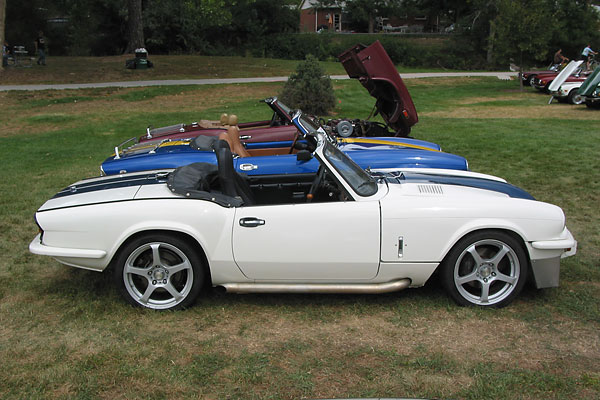 Photo: britishv8.org
A 1979 Triumph Spitfire rebuilt with a turbocharged Ford 2.3L four
Max Brewster swapped his Spitfire's engine for a turbocharged Ford 2.3L four, then built a custom coilover independent rear suspension and Mazda RX7-based brakes and differential to handle the extra power. The write-up is notable for its detailed junkyard-parts engineering, including a machined spindle adapter and a reworked GT6 bonnet for engine clearance.
Specs
As the owner states it.
- Engine
- 2.3L Ford Turbo, factory rated 190 HP and 240 lb ft torque @3400 RPM
- Fuel Injection
- Upgraded to Turbo T-bird VAM, with computer and temperature sensor
- Wiring Harness
- From 1986 Merkur XR4Ti
- Intake
- Modified for clearance, stock cam, Porsche 944 intercooler
- Exhaust
- Side pipe
- Cooling
- Griffin aluminum radiator
- Transmission
- Borg Warner T5 5-speed with 0.79:1 overdrive, custom driveshaft, Triumph clutch hydraulics
- Rear Axle
- Second generation Mazda RX7 differential housing with first generation limited slip third member, 3.909:1 gear ratio
- Front Suspension
- Stock Triumph
- Rear Suspension
- Custom coilover IRS with unequal length control arms and custom antisway bar, designed by owner
- Brakes (master)
- Stock Triumph master cylinder with adjustable proportioning valve
- Brakes (front)
- 1989 Mazda RX7 GXL 11 inch rotors and 4-piston calipers
- Brakes (rear)
- 10 inch ventilated rotors with single piston calipers
- Wheels/Tires
- 16x7 Rage 5-spoke aluminum wheels with 205x40x16 BFG g-Force tires
- Instruments
- Cobra style 160 MPH electronic speedometer and boost gauge, stock Smiths gauges for fuel, temp, oil pressure, etc.
- Body
- 1968 GT6 bonnet section raised and welded to Spitfire bonnet, aluminum front air dam, relocated hinged rear license plate concealing receiver hitch
- Interior
- Mazda Miata seats
- Weight
- 2080 pounds
- Completed
- November 2004, approximately 20,000 miles driven as of January 2008
Parts used
What the owner names in the write-up, grouped the way the Parts page groups them. Where one of the shops we index lists the same thing for this car, it is shown underneath with a link to the shop.
Engine 2
- Ford 2.3L Turbo engineFord
Base engine for the swap, factory rated 190 HP and 240 lb ft torque
- Porsche 944 intercooler
Fitted to the turbo system for charge cooling
Fuel & Ignition 1
- Turbo T-bird VAM fuel injection system
Used to upgrade the engine's fuel injection, computer and temperature sensor
Cooling 1
- Griffin aluminum radiatorGriffin
Used for engine cooling
Gearbox & Drivetrain 5
- Borg Warner T5 5-speed gearboxBorg Warner
Fitted with 0.79:1 overdrive as the transmission
In the shops Borg & Beck Clutch Kit ↗
 Moss Motors – Triumph TR6/TR250· $210.00 USD
 Borg & Beck Clutch Kit ↗Moss Motors – Triumph TR6/TR250· $212.00 USD
 5-Speed Gearbox Conversion Kit (Frontline) ↗Moss Motors – Triumph TR6/TR250· $7,337.00 USD
 - Custom driveshaft
Made to connect the T5 gearbox to the rear differential
- Triumph clutch hydraulics
Used to operate the clutch with the swapped drivetrain
In the shops Clutch Hydraulics Refresh Bundle ↗
 Flyin' Miata· $362.47 USD
 Clutch Hydraulics (Mk VII, Mk VIII, Mk IX) ↗Moss Motors – Triumph TR6/TR250· $0.00 USD
 - Mazda RX7 second-generation differential housingMazda
Used as rear axle housing, chosen for removable outer bearing housings
In the shops Stock Mazda Engine Mount ↗Flyin' Miata· $60.99 USD
 Differential Housing Gasket ↗Moss Motors – Triumph TR6/TR250· $0.95 USD
 Mazda Washer Pump Grommet (NA/NB) ↗Flyin' Miata· $5.79 USD
 - Mazda RX7 first-generation limited slip third memberMazda
Provided 3.909:1 limited-slip differential gearing
In the shopsStock Mazda Engine Mount ↗Flyin' Miata· $60.99 USDMazda Washer Pump Grommet (NA/NB) ↗Flyin' Miata· $5.79 USD Mazda Exhaust Manifold Nut (1990-05) ↗Flyin' Miata· $11.99 USD
Suspension & Steering 3
- Custom coilover independent rear suspension
Designed by owner with unequal length control arms
- Custom rear antisway bar
Designed and fabricated by owner for the rear IRS
- Shortened CV axles
Rebuilt to shorter length by a local vendor to narrow the rear suspension without cutting originals
Brakes 3
- Adjustable proportioning valve
Added to the stock Triumph master cylinder brake circuit
In the shops Complete Adjustable Brake Proportioning Kit ↗Flyin' Miata· $74.99 USD
 - 1989 Mazda RX7 GXL 11 inch front rotors and 4-piston calipersMazda
Fitted to the front using a machined adapter spindle and caliper mounting plate
In the shops Genuine Mazda Front Wheel Hub & Bearing Assembly F189-33-04X ↗
 MazSpec MX-5 Spares & Accessories· £257.95 GBPStock Mazda Engine Mount ↗Flyin' Miata· $60.99 USDMazda Washer Pump Grommet (NA/NB) ↗Flyin' Miata· $5.79 USD
 - 10 inch ventilated rear rotors with single piston calipers
Used for rear braking, retained from the Mazda RX7 rear axle assembly
In the shopsHandbrake Cable to Caliper Pin (Non-Ventilated Rear Discs) ↗Motaclan Limited· £1.89 GBP
Rear Brake Caliper Assembly RH (Non-Ventilated Disc Brakes) ↗Rear Brake Caliper Assembly LH (Non-Ventilated Disc Brakes) ↗
Wheels & Tyres 2
- Rage 5-spoke aluminum wheelsRage
16x7 wheels fitted to the car
- BFG g-Force tiresBFGoodrich
205x40x16 tires fitted to the Rage wheels
Body & Trim 2
- Triumph GT6 bonnet center section
Raised and welded to Spitfire bonnet sides for engine clearance
In the shopsCenter Panel Bonnet Skin ↗Moss Motors – Triumph TR6/TR250· $0.00 USD Triumph Spitfire Mk3 Bonnet Badge ↗
 TRGB· £13.75 GBP
 Triumph Spitfire Mk4 Bonnet Badge ↗TRGB· £15.35 GBP
 - Aluminum front air dam
Fabricated and fitted to the front of the car
Interior 1
- Mazda Miata seatsMazda
Fitted as the car's seats
In the shopsStock Mazda Engine Mount ↗Flyin' Miata· $60.99 USDMazda Washer Pump Grommet (NA/NB) ↗Flyin' Miata· $5.79 USDMazda Exhaust Manifold Nut (1990-05) ↗Flyin' Miata· $11.99 USD
Electrical 3
- 1986 Merkur XR4Ti wiring harness
Used to wire the engine swap
In the shops Wiring Harness Tape ↗Moss Motors – Triumph TR6/TR250· $12.75 USDBody Wiring Harness ↗Moss Motors – Triumph TR6/TR250· $158.00 USDMain Wiring Harness ↗Moss Motors – Triumph TR6/TR250· $736.39 USD
 - Cobra style 160 MPH electronic speedometerCobra
Fitted along with a boost gauge for instrumentation
In the shops Speedometer Assembly - 110 MPH ↗Moss Motors – Triumph TR6/TR250· $402.00 USDSpeedometer Gauge MPH (1974-77) - Midget ↗Speedometer Gauge MPH (1967-70) - Sprite/Midget ↗
 - Stock Smiths gaugesSmiths
Used for fuel, temperature and oil pressure readouts
In the shops Smith's Gauge Bulb (3W, Wedge Base) ↗Moss Motors – Triumph TR6/TR250· $1.05 USDSmiths 60mm Clock Gauge ↗Smiths 52mm Clock Gauge ↗
Photos
All 27 pictures in the write-up, in the order they were posted, shown from britishv8.org. A picture opens larger here, with the way through to the page it is on.
How it was done
Starting point
The Spitfire began as a stock car until a steep hill convinced Max an engine swap was necessary. He decided to fit a turbocharged Ford 2.3L four in place of the original engine.
Engine and fuel system
The 2.3L Ford Turbo, factory rated at 190 HP, was fitted with upgraded Turbo T-bird VAM fuel injection, a computer and temperature sensor, and wiring from a 1986 Merkur XR4Ti. A Porsche 944 intercooler was added, the intake was modified for clearance, and a Griffin aluminum radiator handled cooling.
Drivetrain
Power goes through a Borg Warner T5 five-speed with 0.79:1 overdrive, a custom driveshaft, and Triumph clutch hydraulics. Max chose a second-generation Mazda RX7 differential housing with a first-generation limited-slip third member and 3.909:1 gears, picked because its bearing housings could be removed for mounting custom control arms.
Rear suspension
Max designed a custom coilover independent rear suspension with unequal length control arms and a custom antisway bar. Using the stock RX7 housings let him also keep the Mazda brakes and handbrake cables. A local CV axle rebuilder matched shorter axles to narrow the suspension without cutting the originals.
Front brakes and spindles
To fit 1989 Mazda RX7 GXL 11 inch rotors and 4-piston calipers up front, Max machined a spindle combining the Triumph tapered shaft with the Mazda rotor profile, and built an adapter plate to mount the calipers.
Bodywork for clearance
To clear the engine, Max parted out a Triumph GT6 and welded its bonnet center section, raised about an inch higher than stock, onto the Spitfire bonnet sides. He also cut down and rotated the upper intake manifold 90 degrees before welding it to the lower intake.
Interior, wheels and finishing
Mazda Miata seats were fitted, along with a Cobra style 160 MPH electronic speedometer, a boost gauge, and stock Smiths gauges. The car rides on 16x7 Rage five-spoke wheels with 205/40/16 BFG g-Force tires, finished with an aluminum front air dam and a relocated, hinged rear license plate hiding a receiver hitch.
Ongoing plans
Completed in November 2004 and driven about 20,000 miles by January 2008, the car still needs a finished interior with wood dash and carpet. Max plans to rebuild the transmission with different gearing, is fabricating a roll bar, and has started building a Spitfire-based trailer for extra luggage room.
A summary in our own words. The full account, with all its detail, is the owner's: read it at britishv8.org ↗
Worth knowing
- Using complete junkyard assemblies, like the RX7 differential housing, made it easier to reuse matching brakes and handbrake parts.
- Choosing a differential with removable outer bearing housings simplified attaching custom control arms.
- Having a specialist rebuild shorter CV axles avoided the weakness of cutting and welding the originals.
- Machining an adapter spindle let stock Triumph uprights accept Mazda brake rotors directly.
- Reworking a GT6 bonnet section solved engine clearance without a full custom bonnet build.