Build catalogue
Jim Prettyleaf's 1971 TR-6 with Buick 231 V6
britishv8.orgas published in BritishV8 Magazine, Volume XVI Issue 2, October 2008
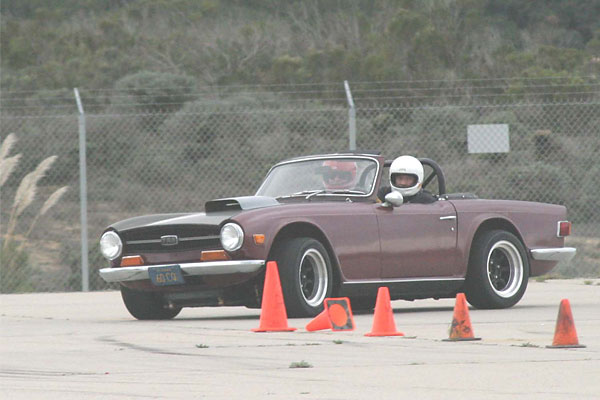 Photo: britishv8.org
A 1971 TR-6 rebuilt around a Buick 231 V6 with custom IRS
Jim Prettyleaf's TR-6 has gone through three rebuilds since 1977, ending with a hotted-up Buick 231 V6 making roughly 300 horsepower. The write-up focuses on the engineering behind a stiffened chassis, a homemade three-link independent rear suspension built around a Corvette differential, and stronger driveline parts able to handle the added power. It is a detailed look at solving the TR-6's known chassis flex and stub-axle weaknesses.
Specs
As the owner states it.
- Engine
- 1984 Buick 231cid (3.8L) V6, 10:1 compression, Edelbrock Performer intake, Holley 390cfm four barrel carburetor, MSD ball bearing distributor with MSD 6AL spark box, Kenne Bell "Mark 2X" camshaft (intake 0.478" lift/270 duration, exhaust 0.494" lift/280 duration), 1.6:1 roller rockers
- Exhaust
- Custom 3-into-1 headers fabricated by San Francisco Muffler
- Cooling
- Custom radiator using stock TR-6 top and bottom tanks with enlarged inlets/outlets and a 3-row core, electric pusher fan
- Transmission
- Muncie M21 4-speed with 1:1 top gear, lightweight billet steel flywheel, 10.4" Centerforce clutch, hydraulic throw-out bearing, custom driveshaft and halfshafts by San Jose Drive Line
- Rear axle
- Chevrolet Corvette C3 differential with limited slip and 3.54:1 final drive
- Suspension
- Front: modified TR-6 with 6 degrees castor and 3 degrees negative camber, using "Uncle Jack Drews" spindles. Rear: custom 3-link independent rear suspension with bespoke halfshafts and Summers Brothers stub axles
- Chassis
- Added triangulation front and rear plus chassis brace with integrated roll bar; body solidly mounted to frame with aluminum spacers for longitudinal bracing
- Brakes
- High coefficient rear brake linings with 0.87" diameter rear wheel cylinders from Sunbeam Alpine/Tiger, Wilwood brake bias valve for front-to-rear balance
- Wheels
- Carroll Shelby 15x8.5 8-spoke wheels
- Tyres
- Hoosier A6 225/45ZR15 autocross tyres
- Weight
- 2426 pounds
- Interior
- Auto Meter Sport Comp "Monster" tachometer with stock 1971 TR-6 white on black gauges
Parts used
What the owner names in the write-up, grouped the way the Parts page groups them. Where one of the shops we index lists the same thing for this car, it is shown underneath with a link to the shop.
Shop suggestions are being prepared. The owner's parts list is available below.
Engine 4
- Buick 231cid (3.8L) V6 engineBuick
1984 unit built to 10:1 compression as the swap engine
- Kenne Bell "Mark 2X" camshaftKenne Bell
High lift/duration cam for increased power
- 1.6:1 roller rockers
Used with the camshaft, requiring tall valve covers to clear
- Custom 3-into-1 headersSan Francisco Muffler
Fabricated to exhaust the V6 efficiently
Fuel & Ignition 4
- Edelbrock Performer intake manifoldEdelbrock
Fitted to the Buick V6 for improved breathing
- Holley 390cfm four barrel carburetorHolley
Mounted on the Edelbrock intake to feed the engine
- MSD ball bearing distributorMSD
Provided ignition timing for the V6
- MSD 6AL spark boxMSD
Ignition amplifier paired with the MSD distributor
Cooling 2
- Custom 3-row radiator core
Built into stock TR-6 tanks with enlarged inlets/outlets for better cooling
- Electric pusher fan
Added for cooling airflow
Gearbox & Drivetrain 6
- Muncie M21 4-speed transmissionMuncie
Close-ratio gearbox with 1:1 top gear fitted behind the V6
- Billet steel flywheel
Lightweight flywheel for quicker engine response
- 10.4" Centerforce clutchCenterforce
Clutch paired with hydraulic throw-out bearing
- Custom driveshaftSan Jose Drive Line
Fabricated to suit the drivetrain swap
- Custom halfshaftsSan Jose Drive Line
Built strong enough to transmit over 400 horsepower
- Chevrolet Corvette C3 differentialChevrolet
Limited slip unit with 3.54:1 final drive, mounted on reinforced steel mounts with its own rubber mounts
Suspension & Steering 4
- "Uncle Jack Drews" front spindlesUncle Jack Drews
Used to set 6 degrees castor and 3 degrees negative camber up front
- Summers Brothers stub axlesSummers Brothers
Replaced weak stock stub axles to handle high power
- Custom three-link independent rear suspension
Homemade leading-link and transverse-link IRS built around the Corvette differential
- Panhard rod
Connects differential mount to frame rail to control lateral movement
Brakes 2
- Sunbeam Alpine/Tiger rear wheel cylindersSunbeam
0.87" diameter cylinders fitted with high coefficient linings for rear brakes
- Wilwood brake bias valveWilwood
Adjusts front-to-rear brake balance
Wheels & Tyres 2
- Carroll Shelby 15x8.5 8-spoke wheelsCarroll Shelby
Fitted for the rebuilt car
- Hoosier A6 225/45ZR15 tyresHoosier
Autocross tyres fitted to the Shelby wheels
Interior 1
- Auto Meter Sport Comp "Monster" tachometerAuto Meter
Added alongside the stock 1971 TR-6 gauges
Photos
All 13 pictures in the write-up, in the order they were posted, shown from britishv8.org. A picture opens larger here, with the way through to the page it is on.
How it was done
Three generations of one swap
This TR-6 has been rebuilt three times. The first, in 1977, used an odd-fire 225cid Buick V6. The current third version, finished in 2003, uses an even-fire 231cid V6 and had covered about 6000 miles by mid-2008. Each version aimed to put more power through a chassis that was never designed for it.
Building the engine
The 3.8 litre Buick V6 runs 10:1 compression with an Edelbrock Performer intake, Holley 390cfm carburetor, MSD ignition, a Kenne Bell camshaft and 1.6:1 roller rockers, producing about 300 horsepower at the crank. Custom 3-into-1 headers were fabricated by San Francisco Muffler, and a radiator was rebuilt using stock tanks with a larger 3-row core.
Stiffening a flexible frame
The owner found stock TR-6 frames too flexible for the added torque, causing the car to jump sideways on hard upshifts in an earlier version. The fix was triangulated bracing at the front and rear of the frame plus a chassis stiffener with an integrated roll bar, weighing 45 pounds, solidly mounting the body to the frame with aluminum spacers.
Swapping in a Corvette differential
To handle the extra power and cure weak stock differential mounts, a Chevrolet Corvette C3 limited-slip differential was fitted on reinforced, lightweight cellular steel mounts, connected to the chassis stiffener by triangulated steel tubes, using the Corvette's own captive rubber mounts.
Designing a new rear suspension
A homemade three and one half link independent rear suspension replaces the stock semi-trailing arm design. It uses a leading link into the original trailing arm mounting holes, the rotating halfshaft itself as the upper transverse link, a threaded lower transverse tube with spherical rod ends, and a Panhard rod to control lateral movement of the differential.
Stronger driveline parts
Custom halfshafts and Summers Brothers stub axles were built to handle over 400 horsepower, replacing the TR-6's original weak stub axles that break under a hotter stock engine. A Muncie M21 close-ratio four-speed transmission, lightweight flywheel and Centerforce clutch complete the drivetrain.
How it drives
The owner reports the car handles with strong tactile feedback and sticks hard in corners, though it is not as quick in a straight line as some V8 conversions. Weight distribution is 48% front and 52% rear without the driver. Reducing rear camber from -2.5 to -2.0 degrees notably improved rear grip, and fine tuning continues.
A summary in our own words. The full account, with all its detail, is the owner's: read it at britishv8.org ↗
Worth knowing
- Stock TR-6 frames are too flexible for added V6/V8 torque and need chassis stiffening to avoid torque steer on upshifts.
- The stock independent rear suspension and stub axles are too weak for more powerful engines and will break under increased torque.
- A custom three-link IRS built around a Corvette differential gathers up faster and has less camber change than the stock semi-trailing arm setup.
- Reducing rear camber slightly, from -2.5 to -2.0 degrees, improved rear grip noticeably.
- Reinforcing differential mounts and using triangulated cross members is necessary to handle rear wheel reaction torque and driveline torque.